

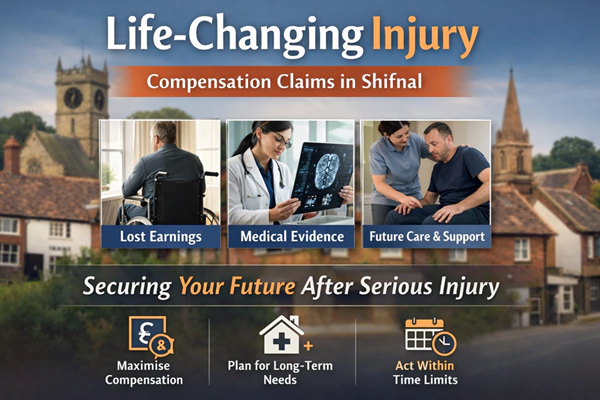
Life-changing injuries do not just interrupt life. They reshape it. In Shifnal, people who suffer serious, permanent injuries often focus first on coping day to day, adapting routines, and managing uncertainty. Only later does the question of compensation arise, usually when it becomes clear that the injury will affect work, independence, or long-term plans.
Maximising compensation in life-changing injury cases is not about chasing numbers. It is about ensuring the compensation reflects the full, long-term reality of what has been lost and what support will be needed going forward.
What makes an injury “life-changing”
A life-changing injury is one that permanently affects how you live, work, or function. This can include spinal injuries, serious brain injuries, loss of limb function, chronic pain conditions, or injuries that prevent a return to previous employment.
Some injuries are immediately recognised as life-changing. Others become clear only after months of treatment and attempted recovery. In Shifnal, many people begin with the expectation of improvement, only to realise that limitations are permanent.
This distinction matters because life-changing injury compensation focuses on future needs, not just past harm.
Why maximising compensation matters
Standard injury claims often focus on recovery. Life-changing injury claims focus on sustainability.
The purpose of maximising compensation is to ensure that future financial pressure, care needs, and loss of independence are addressed now, rather than becoming crises later. Underestimating long-term impact is one of the most common and costly mistakes in serious injury claims.
Once a claim is settled, it cannot usually be reopened. Getting it right the first time is critical.
Key areas that affect compensation value
In life-changing injury cases, compensation is built around several core areas. Loss of earnings is often significant, particularly where a return to previous work is no longer possible. Future loss of income may extend over decades.
Medical treatment and rehabilitation costs are also central. This may include ongoing therapy, specialist treatment, pain management, or psychological support. Equipment such as mobility aids or adapted vehicles may also be required.
Care and assistance are frequently overlooked. Even if family members provide help, the law recognises the value of that care. Home adaptations, changes to daily routines, and reduced independence all factor into compensation.
The importance of long-term medical evidence
Maximising compensation relies heavily on accurate medical evidence. This is not limited to diagnosing the injury, but understanding how it will affect you long term.
Medical experts may assess prognosis, future treatment needs, work capacity, and daily limitations. These reports help ensure that compensation reflects realistic outcomes rather than optimistic assumptions.
Rushing a claim before the long-term picture is clear often leads to undervaluation.
Interim payments and early support
In some life-changing injury cases, interim payments may be available before a claim is fully resolved. These payments can help fund rehabilitation, care, or adaptations while the case continues.
This aspect of compensation is particularly important where injuries prevent work or create immediate financial strain. Early support can improve recovery outcomes and reduce stress.
Why claims are rarely straightforward
Life-changing injury claims are complex because they involve uncertainty. We cannot always predict future health, employment prospects, and care needs with precision.
For this reason, claims require careful evidence gathering and realistic forecasting. Oversimplifying future impact may result in compensation that falls short of what is actually needed.
Maximising compensation means planning reasonable worst-case scenarios, not best-case optimism.
Time limits still apply
Even in serious cases, time limits apply. Most life-changing injury claims must be started within three years, although exceptions exist in certain circumstances.
Because recovery can take time, it is easy to lose sight of deadlines. Early advice ensures that your right to claim is protected while long-term needs are properly assessed.
How Marley Solicitors can help
Marley Solicitors advises clients in Shifnal and across Shropshire who have suffered life-changing injuries. We focus on building claims that reflect long-term reality, not short-term disruption.
Our approach prioritises careful medical evidence, realistic future planning, and securing compensation that supports independence, dignity, and stability.
Making informed decisions after a life-changing injury
If you or a family member has suffered a life-changing injury in Shifnal, understanding how compensation is assessed can help you avoid costly mistakes. These claims are not about speed. They are about accuracy.
Clear advice early on helps ensure that decisions made now support your future, not just your immediate recovery.